
Bliss (video game)
A romance game for couples, played in bed.

Dedvalson at English Wikipedia · Public domain
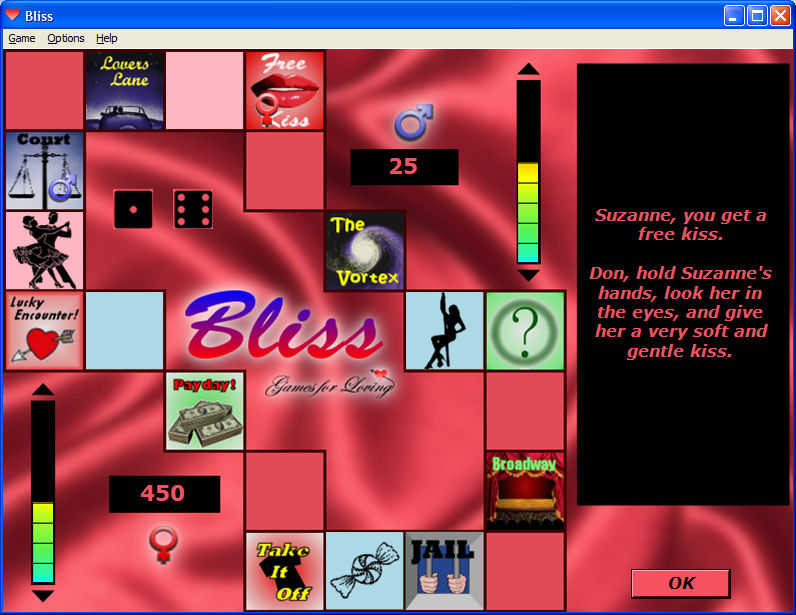
Bliss is a 2005 video game from American independent software publisher Games for Loving. It is intended to be played in bed with a sexual partner and is loosely based on the board game Monopoly, guiding players through various sexual activities including removing their clothing.
- Release Year
- 2005
- Publisher
- Games for Loving
- Country of Origin
- United States
- Genre
- Romance/sex game
- Platform
- Not specified in source
- Notable Feature
- No pornography or pictures of people
Lore & Background
Bliss is designed for two players in bed, who begin by supplying information about themselves, their environment, available toys (such as Ice Cubes or a Vibrator), detailed descriptions of what they are wearing, and their current mood, called a Passion Level. Players can create and edit Profiles specifying which sexual activities they do or do not like. Gameplay involves taking turns rolling dice, moving around a board, and performing Actions selected by the game, ranging from talking and stripping to dancing and explicit sexual activities. Music plays softly throughout, and certain Actions allow players to select a song to play for that action, with encouragement to use their own favorite music. As the game progresses, each player's Passion Level increases, unlocking more explicit actions, starting with talking, hugging, or soft kisses and moving to intimate physical contact. An Action Editor is available at extra cost for creating or editing actions, and Add On Packs can change the game's feel by adding new actions.
Reader's Guide
Bliss holds a unique place in video game history as a title explicitly designed for couples to play in bed, blending board game mechanics with sexual activity. Its publisher promoted it as a romance game rather than a sex game, and it notably contains no pornography or pictures of people, a distinction that led to positive reception from several pro-family and even Christian web sites. Public reaction has been mixed, but Wired.com reviewed it favorably in their Sex Drive column. The game's significance lies in its attempt to use interactive media to facilitate intimacy between partners, offering customizable profiles and actions to suit individual preferences. Its legacy is as an early example of a niche genre that straddles the line between romance and explicit content, with a focus on player-generated experience rather than pre-rendered imagery.
Did You Know?
- Bliss is loosely based on the board game Monopoly.
- Players can specify available toys such as Ice Cubes or a Vibrator at the start of the game.
- An Action Editor is available at extra cost for creating custom actions.
- The game includes no pornography or pictures of people.
Board-Game Roots and the Passion Curve
Bliss draws its structural DNA from the classic property-trading board game Monopoly, translating the familiar rhythm of rolling dice, advancing around a track, and responding to whatever space you land on into an intimate two-player experience meant to be enjoyed in bed with a sexual partner. Rather than buying properties, players perform Actions that the game selects for them each turn. These range from simple conversation and a gentle hug in the early rounds to dancing, stripping, and increasingly explicit physical contact as the session progresses. The central pacing mechanism is the Passion Level, a shared meter that climbs slowly over the course of a game. This design choice means the experience builds organically: what begins as soft kisses and tender talk naturally escalates into more intimate territory, mirroring how a real evening between partners might unfold. Soft background music underscores the whole session, and specific Actions give players the option to queue up a particular song to accompany a strip or dance sequence. The developers actively encourage couples to swap in their own playlists, making the soundscape as personal as the gameplay itself.
Profiles, Toys, and the Action Editor
Before a single die is rolled, Bliss asks each player to describe their immediate situation in granular detail. The setup prompts cover what clothing each partner is wearing, what toys might be within reach (the game's own examples include Ice Cubes and a Vibrator), and the couple's starting mood, which the software labels the Passion Level. Beyond that one-time setup, players can build persistent Profiles that record which categories of sexual activity they enjoy and which they prefer to skip, ensuring the game's random Action selections stay aligned with both partners' comfort. For those who want even deeper control, an Action Editor is sold as a separate paid add-on. Through it, couples can write entirely new Actions from scratch or modify any of the ones bundled with the base game. Additional Add On Packs are also available, each injecting fresh Actions into the rotation to shift the overall tone and variety of a session. Together, these customization layers mean no two couples need to experience Bliss in quite the same way, and the game can evolve alongside a relationship as preferences change over time.
A Romance Game, Not a Sex Game
Games for Loving has always marketed Bliss under the banner of romance rather than explicit sexuality, and that positioning has shaped both how the product looks and how audiences receive it. The game contains no pornography and no photographs of people, a deliberate choice that sets it apart from other adult-oriented titles in the same niche. This restraint has proven to be a genuine differentiator in the marketplace: several pro-family websites and even Christian-oriented blogs have reviewed Bliss favorably, framing it as a tool for married couples to deepen intimacy without crossing into territory they consider inappropriate. The mainstream tech press was equally welcoming; Wired.com gave the game a positive review in its Sex Drive column, and Linux Gaming News also covered it. Meanwhile, niche communities such as Marriage Vineyard, the Christian Nymphos blog, and the Married Sex Blog all published entries discussing the title. The overall public reaction, however, remains mixed, with the game finding passionate advocates in some circles while drawing skepticism in others.
Games for Loving and the Independent Niche
Bliss: The Game for Lovers arrived in 2005 from Games for Loving, an American independent software publisher whose very name signals the company's singular focus. Rather than competing with the major studios that dominated the mid-2000s gaming landscape, Games for Loving carved out a tightly defined niche: software designed specifically for couples in a romantic or marital context. The full title of the game, with its explicit "for Lovers" tag, reinforces that branding and makes clear the intended audience at a glance. As an independent publisher, Games for Loving had the freedom to build a product around a concept that larger companies would likely avoid, sidestepping the corporate risk-aversion that typically keeps intimate, relationship-focused software off the shelves. The 2005 release placed Bliss in an era when the internet was rapidly creating new communities of reviewers and bloggers who could champion a small, unconventional title to a wider audience. The publisher's official website remains the primary hub for those seeking to learn more about the game and its companion add-on products.
Gallery





More in Erotic video games 1-24
Spotted an error? Know more?
This is a living reference — every entry is fact-audited, and reader corrections feed straight into our audit queue. Suggest an edit · See this site's audit record